
Published on 3/20/2026 by Emilie SOLÈR
Last updated : 3/20/2026
Introduction : Managing Cloud Costs as a Strategic Priority
Cloud computing gives businesses flexibility, scalability and faster deployment. However, without proper oversight, cloud spending can quickly increase due to oversized resources, unused servers and inefficient storage.
For CEOs, CIOs and CTOs, the challenge is to reduce cloud costs without compromising application availability, security or performance. FinOps provides a structured approach by bringing financial management, technical expertise and business requirements together.
FinOps : Understanding Cloud Cost Optimization
FinOps is a financial management approach that helps organizations understand and optimize their cloud spending. It encourages collaboration between IT, finance and business teams to connect infrastructure costs with the value delivered.
Unlike a simple budget cut, this approach is sustainable. It helps to identify unnecessary expenses, anticipate excesses and integrate the financial dimension into technical decisions. The goal is to achieve cloud optimization in the enterprise that reconciles economic efficiency and quality of service.
Why Are Cloud Costs Increasing ?
Cloud expenses often increase due to poorly sized resources, test environments left active or storage volumes that accumulate. Lack of visibility into costs by application or team also makes it difficult to identify unnecessary expenses.
To correct these drifts, companies must analyze their actual consumption, monitor billing variations and define clear responsibilities. Good cloud governance allows for better control of spending while maintaining an infrastructure adapted to operational needs.
Key Strategies to Reduce Cloud Costs
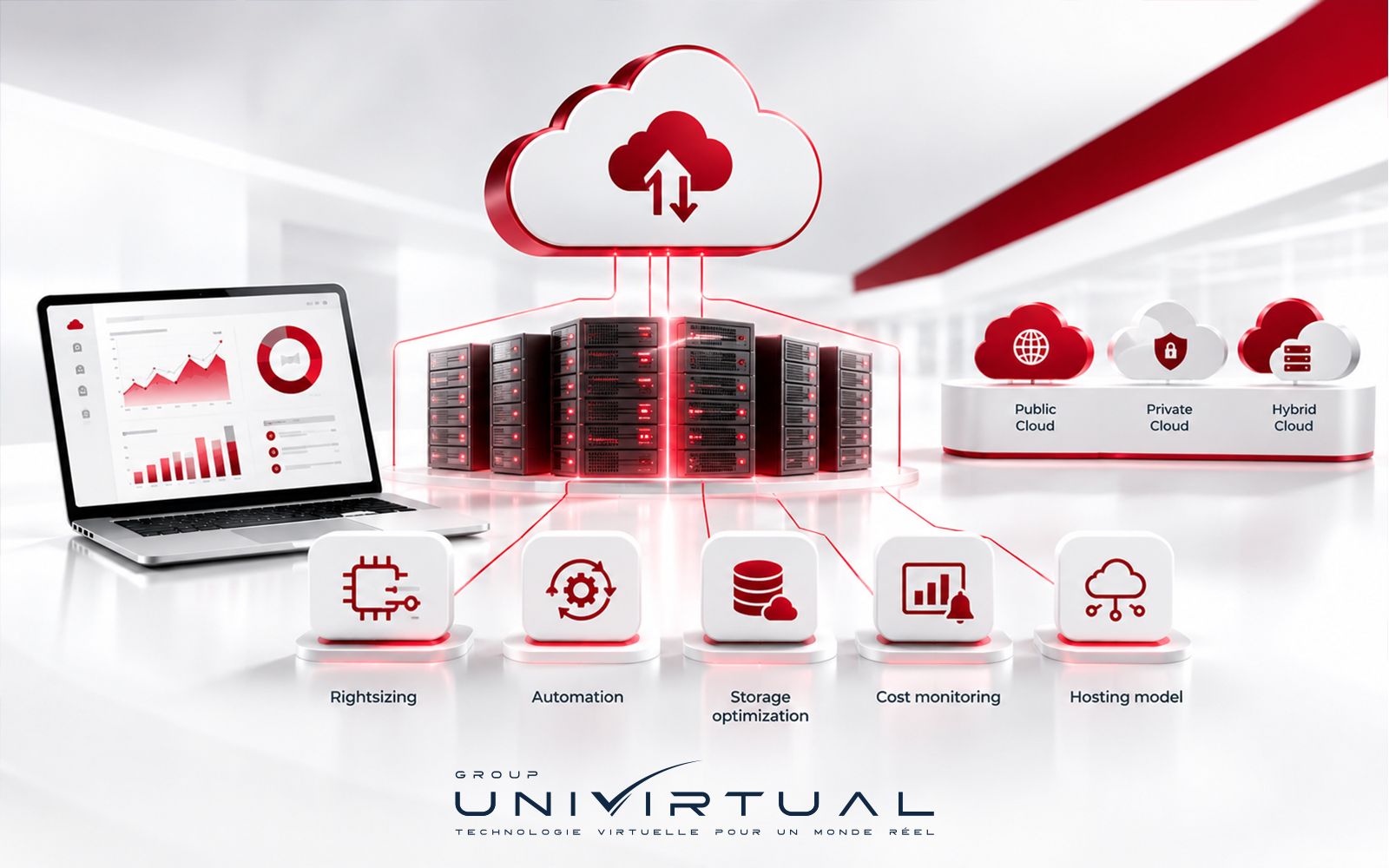
Businesses can improve cloud efficiency through several practical measures :
- Rightsizing : Match CPU, memory and storage capacity to actual demand
- Automation : Shut down development and test environments when they are not needed
- Storage optimization : Archive infrequently accessed data and implement appropriate retention policies
- Cost monitoring : Set budgets, alerts and consumption dashboards
- Infrastructure selection : Compare public cloud, private cloud and hybrid infrastructure models
These measures should be assessed against performance, availability and security requirements. Explore UNIVIRTUAL's cloud solutions to learn more about its cloud and infrastructure offering.
How to Maintain Performance While Optimizing Costs
Reducing cloud costs does not mean cutting resources indiscriminately. Poorly managed optimization can cause application slowdowns, server saturation and service interruptions.
Organizations should monitor CPU and memory utilization, response times and application availability. Cost per service or transaction can also help connect infrastructure spending with business value. Sufficient capacity must remain available to handle peak demand and meet service-level objectives.
FinOps Governance : A Shared Responsibility
Successful FinOps requires collaboration between finance, IT, DevOps and business teams. Each stakeholder should understand how their decisions affect cloud spending and service performance.
Project budgets, consumption alerts and regular reviews help identify cost overruns early. This approach makes cloud cost management an ongoing operational discipline rather than a one-off cost-cutting exercise.
Cloud Sovereignty and Total Cost of Ownership
The price of cloud resources represents only part of their overall cost. Total Cost of Ownership (TCO) also includes software licenses, administration, cybersecurity, backups, maintenance and exit costs.
Data location and access control are equally important. European infrastructure may support digital sovereignty objectives, but organizations should assess contractual guarantees, applicable jurisdictions and data portability arrangements.
The objective is to balance overall cost, security, performance and resilience.
Why Choose UNIVIRTUAL for Cloud Infrastructure ?
UNIVIRTUAL supports businesses with cloud computing, virtualization, storage and high-availability infrastructure solutions. Its datacenters in France and Switzerland support an approach focused on security, performance and control over digital environments.
Cloud cost optimization starts with understanding actual usage and business requirements, then selecting infrastructure that meets technical and operational needs. Discover UNIVIRTUAL's cloud and digital infrastructure solutions to support the evolution of your IT environment.
Conclusion : Making FinOps a Driver of Sustainable Performance
FinOps helps businesses understand cloud expenditure, eliminate unnecessary resource consumption and improve infrastructure efficiency without sacrificing performance.
Success depends on balancing financial optimization, service quality, security and resilience. With the right strategy and governance, cloud computing becomes a more predictable investment aligned with business priorities.